
Parts of a Sailboat: Beginner's Illustrated Guide
Learn the main parts of a sailboat with a labelled dinghy diagram: hull, mast, boom, mainsail, jib, centreboard and rudder. Explore with the YouSail mascot.
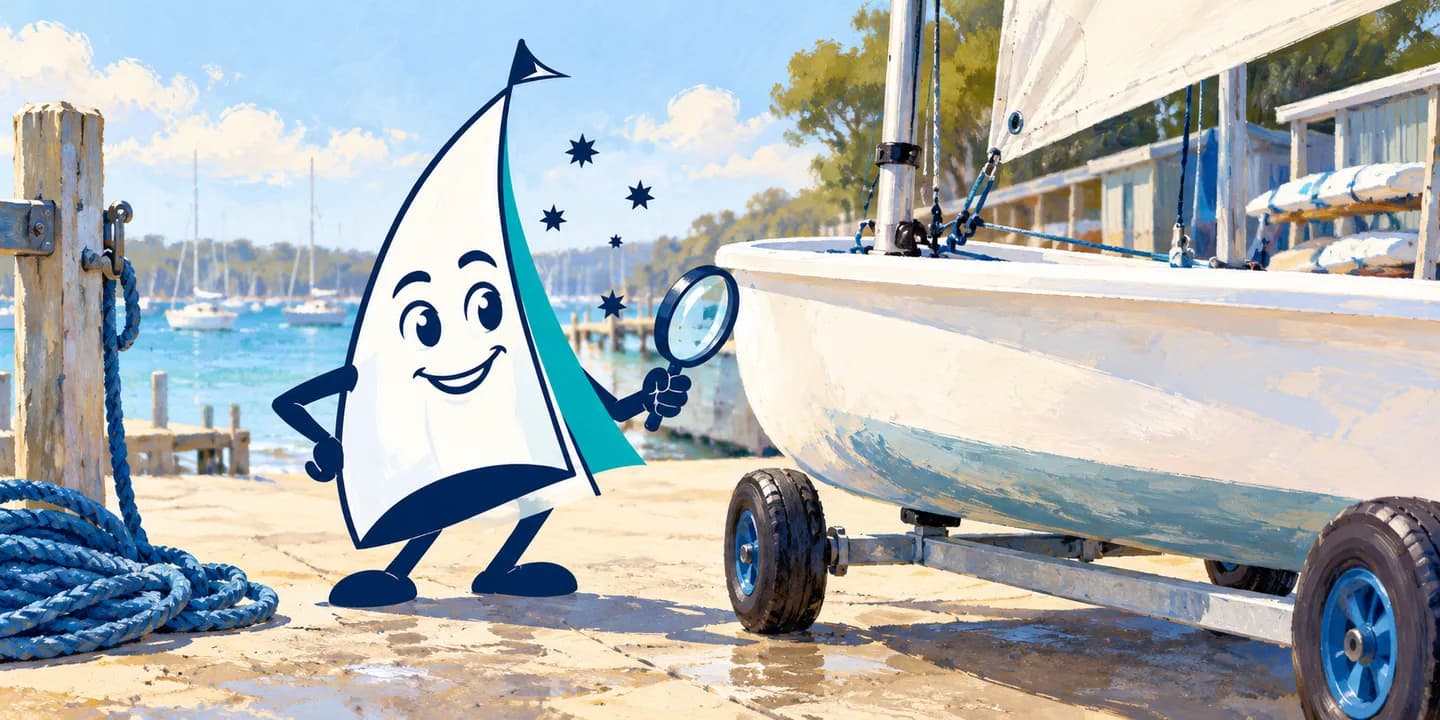
Learn with YouSail · Lesson 2 of 4
See the idea
Check your understanding: Which part is upright: the mast or the boom?
The mast is upright. The boom extends along the lower part of the mainsail in this example. Ask your instructor to identify both on your training boat.
A learning prompt, not a practical skills assessment.Next lesson: Find your way around a boat →
Independent introductory learning, not certification or a substitute for practical instruction. Read the limitations.
On this page
Recognise the boat before learning the controls
A sailboat becomes less mysterious when you can name a few visible parts. Start with the structure, then the sails, then the equipment below the water. Our diagram is a simplified side view of a training dinghy with two sails. It is not a rigging plan and should not be used to assemble a boat.
The boat in your lesson may have one sail, two hulls, a wheel or other differences. Ask the instructor to identify each relevant part on the actual boat before you handle it.
The hull and the rig
The hull is the main body of the boat. The mast is the upright spar supporting the sails. The boom is the spar along the lower part of the mainsail. The mainsail is behind the mast in this example, while the jib is the smaller sail ahead of it.
Look at the diagram, then cover the labels and try to find those five items again. You are practising recognition, not learning which control to pull.
The boom is not a fixed handrail. Ask where it can move and where your instructor wants you to sit or stand. Follow the boat-specific briefing rather than using an illustration to choose a safe position.
Underwater and steering equipment
The centreboard shown beneath the dinghy is a retractable underwater foil that helps resist sideways movement. A rudder changes the boat's direction through the water. On many dinghies, the sailor moves the rudder using a tiller.
The diagram separates these parts so they are easy to identify. It does not show their mechanisms, loading, depth settings or operating limits. Those details are specific to the boat.
Other boats use a daggerboard or a keel rather than the pivoting centreboard illustrated here. Compare the broader families in our boat types section after you are comfortable with the basic labels.
Lines have different jobs
A halyard raises a sail. A sheet controls a sail's angle. They can look similar to a newcomer, so the word “rope” alone may not identify what someone means. The sailing glossary gives short definitions you can revisit.
During a briefing, ask the instructor to point to each relevant line and name it. You might say: “Can you show me which one is the mainsheet?” Do not loosen a line just to discover what it does.
A boat-side observation exercise
Before a supervised session, ask whether there is time to identify the hull, mast, boom and sails together. Point without reaching across unfamiliar equipment. Then ask how that boat is steered and which parts you should avoid touching until instructed.
Finish by identifying the front and back of the boat. The next lesson, port, starboard, bow and stern, connects those fixed directions to the way instructors describe positions.
What this drawing cannot tell you
It cannot establish whether a boat is seaworthy, suitable for your experience or correctly rigged. It also does not show all equipment used for a real session. Your provider's preparation and safety briefing remain essential. Use the course comparison guide to ask about equipment and instruction before booking.
Where to go next
Useful next steps for your sailing plans.



Sources
Framework details on this page were checked against the following. Programs, rule cycles and administration arrangements change, so use the source rather than this page for anything you are relying on.
Last checked 30 September 2026
Sailing information sources and verification
The guide provides editorial context. Named-club records and local directory selections come from YouSail. Club listings, photos and named-club profile details are sourced from YouSail snapshots. The linked YouSail record and club website are the places to confirm what is current. Read the verification methodology.